AI Skin Analyzer Mirror: What It Detects for Better Skincare
AI skin analyzer mirror is transforming skincare into a scientific process. They combine computer vision, machine learning, multispectral imaging, and dermatological databases. The result is a deep, layered analysis of your skin. These systems do not just “look” at your face. They measure, compare, predict, and guide.
1. What can an AI skin analyzer detect?
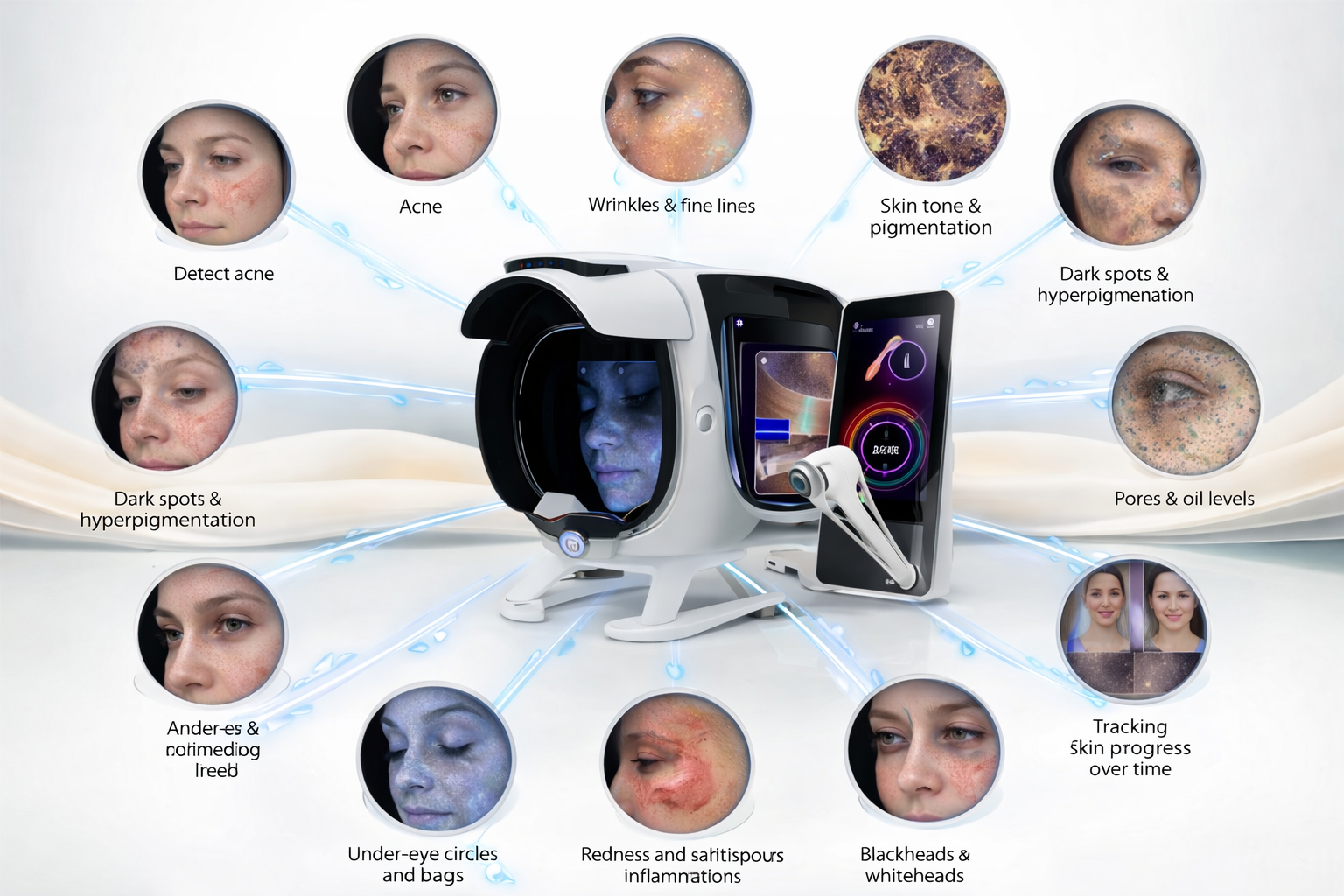
AI skin analyzers detect 10–15 major skin parameters in one scan. Some advanced systems track even more.
Core detection categories:
Surface-level (visible):
- Acne lesions
- Wrinkles and fine lines
- Redness
- Texture roughness
- Visible pores
Subsurface (hidden):
- UV damage
- Early pigmentation
- Collagen loss patterns
- Micro-inflammation
Functional skin metrics:
- Oil (sebum) levels
- Hydration levels
- Elasticity estimation
How it works in detail:
- RGB cameras capture color and texture
- Polarized light removes glare and shows structure
- UV light reveals hidden pigment and damage
- AI models compare your scan with thousands to millions of labeled images
Output format:
- Scores (0–100)
- Heat-maps (colored zones on face)
- Age comparison (your skin vs your actual age)
Why this matters:
In the past, you saw only the surface.
Now, you see current + future risk.
2. Can AI skin analyzer mirrors detect acne?
Yes. They detect acne with clinical-level detail in many cases.
Types identified:
- Comedonal acne (blackheads, whiteheads)
- Inflammatory acne (papules, pustules)
- Nodular or cystic acne
Detection process:
AI analyzes:
- Redness intensity (inflammation marker)
- Shape (raised vs flat)
- Size (micro vs large lesions)
- Clustering (spread pattern)
Advanced data:
- Lesion count per facial zone
- Severity index (mild, moderate, severe)
- Acne distribution map
Extra intelligence:
Some systems estimate causes:
- Excess oil
- Hormonal pattern (jawline acne)
- Poor pore turnover
Guidance quality:
Recommendations often include:
- Active ingredients
- Routine changes
- Lifestyle tips (diet, stress)
3. Do AI skin analyzer mirrors detect wrinkles and fine lines?
Yes. AI skin analyzer mirror detect both micro-lines and deep wrinkles.
Detection technology:
- 3D surface mapping (in advanced systems)
- Shadow and contrast analysis
- Pixel-level depth detection
Measured parameters:
- Wrinkle depth (micron-level estimation)
- Length and spread
- Area coverage percentage
Scientific insight:
Wrinkles form due to:
- Collagen breakdown
- Elastin loss
- Repeated facial movement
AI tracks these changes over time.
Extra feature:
Some tools provide a “skin age score.”
Example: Your skin may appear 5 years older or younger.
4. Can AI mirrors analyze skin tone and pigmentation?
Yes. an AI skin analyzer mirror is one of the most accurate AI functions.
What is analyzed?
- Melanin concentration
- Skin brightness
- Color uniformity
Technology used:
- Multispectral imaging separates pigment layers
- AI maps melanin distribution pixel by pixel
Detailed outputs:
- Evenness score
- Brightness index
- Pigmentation clusters
Hidden detection:
AI can detect pigmentation forming under the surface.
This may appear months later if untreated.
5. Can AI mirrors detect dark spots and hyperpigmentation?
Yes. Detection is both visible and predictive.
Types detected:
- Solar lentigines (sunspots)
- Post-inflammatory hyperpigmentation
- Freckles
- Melasma (in high-end systems)
Detection layers:
- Surface spots (visible light)
- Deep pigment (UV imaging)
Quantitative data:
- Spot count
- Spot area (mm²)
- Pigment intensity
Advanced benefit:
AI distinguishes between:
- Temporary pigmentation
- Chronic pigmentation
This affects treatment choice.
6. Can AI skin analyzer mirrors detect pores and oil levels?
Yes. AI skin analyzer mirror provide high-resolution pore mapping.
Pore analysis includes:
- Size (small, medium, enlarged)
- Density (number per cm²)
- Condition (clean vs clogged)
Oil detection:
- Sebum reflects light differently
- AI measures shine patterns
Data output:
- Oil score (low, normal, high)
- Zone mapping (T-zone vs cheeks)
Scientific insight:
High sebum leads to:
- Acne
- Enlarged pores
Low sebum leads to:
- Dryness
- Barrier damage
7. Can AI skin analyzers help with anti-aging routines?
Yes. AI skin analyzer mirrors are powerful for preventive aging care.
What they detect early:
- Micro-wrinkles
- Loss of firmness
- Uneven texture
Guidance system:
AI suggests:
- Ingredients (retinoids, peptides, antioxidants)
- Routine timing (morning vs night)
- Product layering
Advanced feature:
Some systems simulate aging progression.
They show how your skin may change in 5–10 years.
Why this is important:
Prevention is cheaper and more effective than correction.
8. Can AI mirrors detect hydration levels in skin?
Yes. Hydration is a key health marker.
Detection method:
AI evaluates:
- Surface smoothness
- Light reflection
- Micro-cracks (dehydration lines)
Sensor-based systems:
Some devices use bio-impedance sensors.
They measure actual water content.
Output:
- Hydration score
- Barrier strength estimate
Scientific importance:
Low hydration leads to:
- Faster aging
- Increased sensitivity
- Reduced healing ability
9. Can AI skin analyzer mirrors detect sun damage?
Yes. This is one of the most valuable features of AI skin analyzer.
Detection technology:
UV imaging reveals:
- Subsurface melanin clusters
- DNA-level damage indicators (indirectly)
Types of damage detected:
- UV spots
- Photoaging signs
- Uneven pigmentation
Important insight:
Up to 80% of visible aging comes from sun exposure.
AI advantage:
Shows damage before it appears on the surface.
10. Can AI skin mirrors help improve skincare routines?
Yes. This is where AI becomes practical.
How it improves routines:
- Personalizes product selection
- Adjusts routines based on results
- Eliminates unnecessary products
Data-driven recommendations:
- Ingredient matching
- Skin type adaptation
- Seasonal adjustments
Example:
If oil is high → lighter moisturizer
If dryness is high → barrier repair products
11. Can AI mirrors detect redness and inflammation?
Yes. Detection is highly sensitive.
How it works:
AI tracks hemoglobin signals in the skin.
These signals indicate blood flow.
Conditions detected:
- Irritation
- Allergic reaction
- Rosacea tendency
Data output:
- Redness intensity score
- Area mapping
Clinical relevance:
Chronic inflammation accelerates aging.
12. Can AI skin mirrors detect blackheads and whiteheads?
Yes. AI skin analyzer mirror detect clogged pores accurately.
Detection method:
- Color analysis (dark vs white plugs)
- Shape detection
- Texture irregularities
Detailed output:
- Number of comedones
- Location clusters
- Severity level
Why useful:
Prevents progression into inflammatory acne.
13. Can AI skin analyzers analyze under-eye circles and bags?
Yes. Eye analysis is very detailed.
What is measured?
- Pigmentation (brown/blue tones)
- Puffiness (fluid retention)
- Skin thinning
Types identified:
- Pigmented dark circles
- Vascular dark circles
- Structural hollows
Data output:
- Darkness score
- Puffiness index
14. Can AI skin mirrors detect early signs of skin problems?
Yes. This is a major advantage.
How it works:
AI detects micro-level deviations from normal skin.
Examples:
- Early acne before visible breakout
- Hidden pigmentation
- Initial collagen loss
Why important:
Early intervention is more effective.
It reduces long-term damage.
15. Do AI skin mirrors track skin progress over time?
Yes. Tracking is a core feature of an AI skin analyzer mirror.
How tracking works:
- Stores scan history
- Uses image alignment for accuracy
- Compares metrics over time
Data shown:
- Trend graphs
- Before/after visuals
- Percentage improvement
Example:
Wrinkles reduced by 10%
Hydration improved by 20%
Accuracy and Reliability: How Trustworthy Are They?
AI skin analyzers are generally reliable for cosmetic and surface-level assessments. However:
- They are not a replacement for dermatologists
- Accuracy depends on image quality and algorithm training
- They work best for monitoring and guidance rather than diagnosis
That said, their consistency and ability to track changes over time make them highly valuable.
Why AI Skin Analyzers Are More Beneficial Today Than in the Past
In the past, skincare relied heavily on guesswork, generic advice, and visual inspection. Today, AI brings:
- Personalization: Tailored recommendations based on individual skin data
- Precision: Detection of issues invisible to the naked eye
- Prevention: Early identification of potential problems
- Tracking: Measurable progress over time
This shift from reactive to proactive skincare is one of the biggest advantages of AI technology.
Final Thoughts
AI skin analyzer mirrors are reshaping how we understand and care for our skin. They go beyond surface-level observations, offering deep insights backed by data and machine learning. From detecting acne and wrinkles to analyzing hydration and sun damage, these systems provide a comprehensive view of skin health. While they are not a substitute for professional medical advice, they serve as powerful tools for daily skincare management. In a world where personalization and precision are becoming the norm, AI skin analyzers represent the future of skincare; smart, proactive, and highly individualized. If used consistently, they can help users make informed decisions, optimize routines, and achieve healthier skin with greater confidence.
FAQ’s
More Blogs From Styleminers Skincare
________________________________________________________________________________________________________________